
Cuyahoga Directory Collection Paths
Cuyahoga County historical directory work has two main shelves. Cleveland Public Library's Center for Local and Global History has a complete microfilm set of Cleveland historical volumes, plus an extensive but incomplete paper facsimile set. Cuyahoga County Archives reports a separate Cleveland run from 1837 through 1972, not inclusive. Those statements describe different holdings, so neither one should be used to fill a missing year in the other. The library run is the first stop for a Cleveland name or address; the Archives is the counter-and-research-room fallback when the question needs directories alongside maps, tax records, or local vital material.
| Historical collection | Years or scope | Holding location | Access route |
|---|---|---|---|
| Cleveland historical directory volumes | Complete microfilm set, with known nonpublication years | Cleveland Public Library Center for Local and Global History | Microfilm and department facsimiles |
| Cleveland historical directory volumes | 1837-1972, not inclusive | Cuyahoga County Archives | Research-room collection and request route |
| Digitized Cleveland directories and Blue Books | Selected digitized titles | Cleveland Public Library Digital Gallery | Browse or download online |
| Historic maps and atlases | Selected Sanborn, Hopkins, and aerial material | CPL Digital Gallery and Cuyahoga County Public Library | Digital collection or library resource |
Start by recording the edition year and the municipality printed on the title page. Cleveland proper and nearby suburbs do not always share the same coverage, and a directory title can be more precise than a modern mailing label.
Cleveland Directories on Microfilm
The Cleveland Public Library genealogy guide calls its city-directory microfilm run complete and describes directories as listings for residents, businesses, public buildings, schools, societies, and similar entries. That scope is wider than a phone book, but it is still an edited annual publication. A person can be absent because of the volume's rules, a move, a spelling form, or the publication gap. For a name that appears, copy the spelling, address, occupation, and edition year before turning to another source.
The CPL City Directories and Blue Books collection is the online doorway to selected volumes. It is valuable for a quick edition check, while microfilm remains the complete local run.
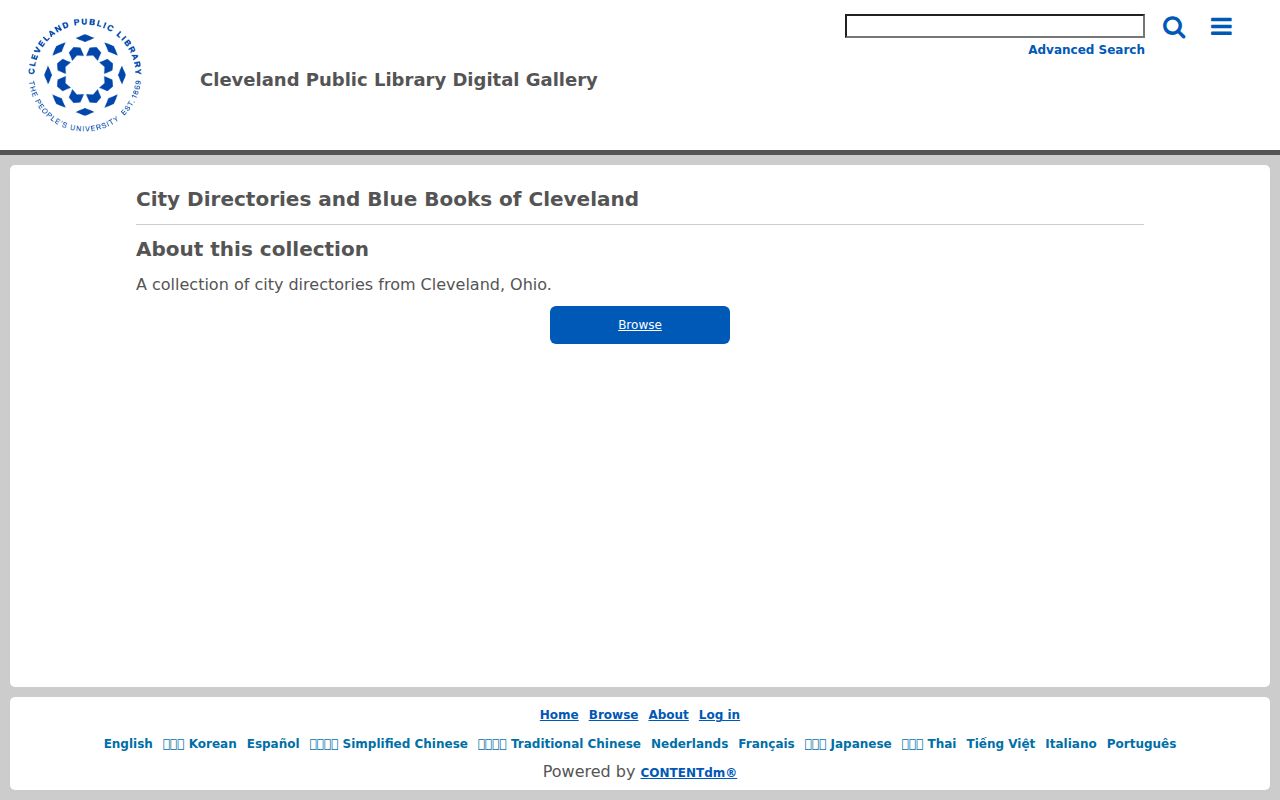
The collection view helps distinguish a digitized selection from the broader microfilm shelf, a key difference when an online search comes up empty.
Cuyahoga Directory Gaps Matter
Cleveland directories were not printed in every year. CPL identifies gaps in 1838-44, 1847-48, 1851-52, 1853-55, 1858-59, 1862-63, 1933, 1945, 1946, 1948, 1949, 1950, 1952, 1962, 1967, 1971, 1973, 1975, and 1976. A missing entry in one of those years says nothing about the household. The same caution applies to a person who vanishes when a suburb begins using a separate title. Keep the nearest available entries on both sides of the gap, then use the title page, maps, tax records, or a census schedule for the intervening period.
- Write down the last confirmed directory edition and the first later edition checked.
- Check whether the target year is a documented Cleveland nonpublication year.
- Read the title page for the municipality coverage before treating a suburb as absent.
- Use the closest dated map or federal census as a bridge, not as a substitute for the missing volume.
Note: A complete microfilm series can still contain years in which Cleveland did not issue a directory, so the edition date must stay attached to every finding.
Reading Cuyahoga Directory Entries
A Cuyahoga County historical directory entry is useful because its fields tie a person to a particular edition. CPL confirms alphabetical listings for people, businesses, public buildings, and societies, with a name, an occupation, and other edition-specific information. Cleveland volumes begin showing wives' names in 1929. Do not silently expand abbreviations or assume that a missing field means the same thing in every edition. The reviewed guide does not publish a full, edition-specific abbreviation key, so photograph or transcribe the front matter from the volume being used.
| Listing name | Use the spelling as printed, then compare variant and former surnames in nearby editions. |
|---|---|
| Entry type | Person, business, public building, school, society, or another category carried by that edition. |
| Occupation | A dated descriptive field that can help separate people with the same name. |
| Address | A listed street address, with the edition year kept beside it rather than treated as a current location. |
| Household clue | Wives' names begin appearing in Cleveland volumes in 1929. |
- Address section
- The property-by-address listing at the end of Cleveland volumes from 1929 onward.
- Alphabetical entry
- The name-ordered listing used to confirm the person or entity after an address lead.
- Abbreviation key
- The volume's front matter, which should be checked before interpreting shorthand in that specific edition.
Cuyahoga Blue Book Limits
The 1895 Cleveland Blue Book is a digitized local item with names and addresses of prominent families and nearby cities. It is not a whole-city census and should never be read as a general resident roll. Its value is narrower: it can help place a family in a selective social directory, suggest a spelling or address for further research, and show that the entry came from a particular kind of publication.
The digital item is worth inspecting before a library visit because its collection metadata identifies the edition and its selective character.
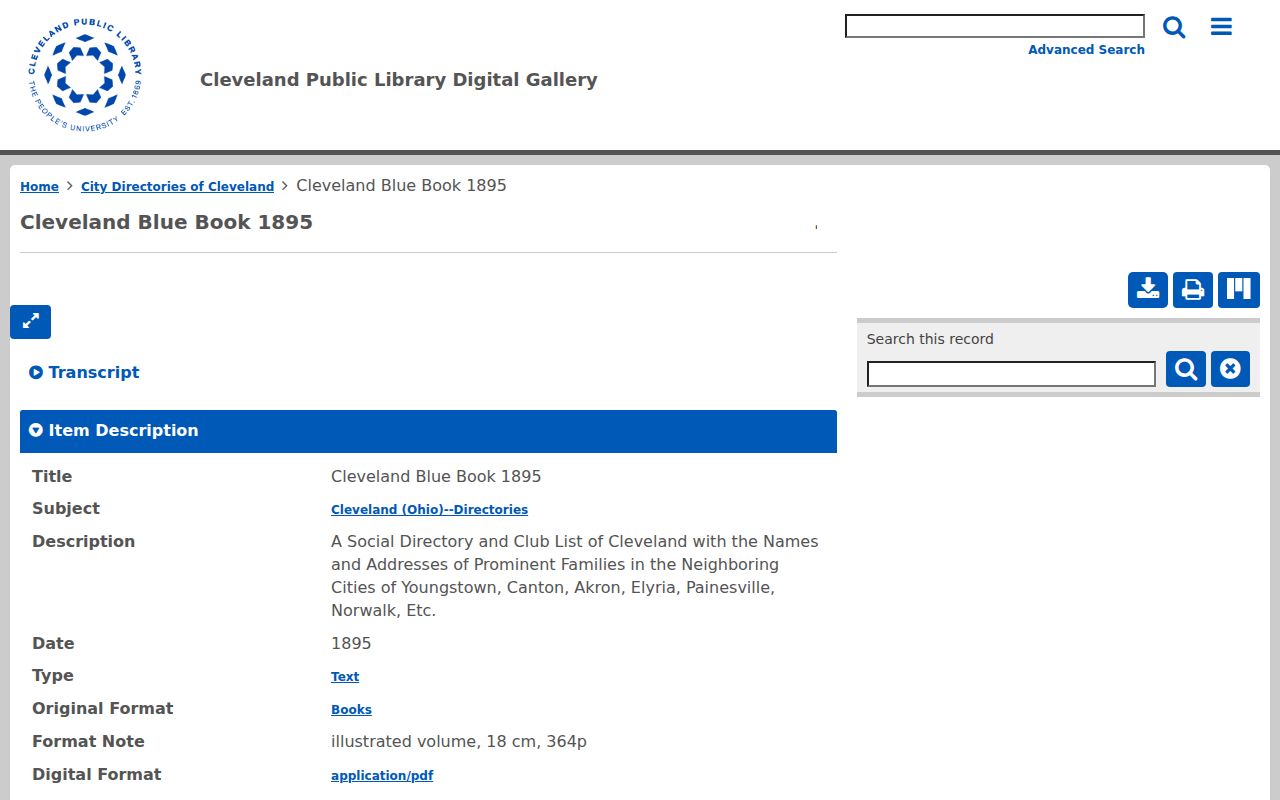
Use a Blue Book entry as a lead to an ordinary directory, map, or archive record, not as proof that every County household was included.
Cuyahoga Directory Shift in 1929
The year 1929 changes the practical value of Cleveland's historical volumes. From that year, the end of each volume lists properties by address, making an old street number a route into the alphabetical listing. The new appearance of wives' names also changes how a household might be indexed. Before 1929, begin with the name and occupation fields, then bring in tax records or maps to support an address question. From 1929 forward, start with either the address section or the name, but keep both entries together in the research note.
This is a historical address tool, not a current address database. For a modern parcel or recorded-document question, the county's address-focused work belongs with the Cuyahoga County street directory path rather than the historical shelf.
Cuyahoga Directory Suburb Coverage
Cleveland directory coverage changes with the title page. Before 1925, some nearby suburbs appeared in the Cleveland volume. From 1925, the title named East Cleveland, Cleveland Heights, Shaker Heights, Bedford, Garfield Heights, Newburgh Heights, Bratenahl, Euclid Village, Lakewood, and Rocky River. Linndale appears from 1927 and University Heights from 1940. By 1951, the title named only Bratenahl, Brooklyn, Garfield Heights, Linndale, and Newburgh Heights, while larger suburbs had begun receiving their own directories during the 1920s.
That pattern gives a practical rule for Cuyahoga County directory research: when a household disappears, test the title-page geography before concluding it moved. A Cleveland mailing label can also mask a different municipality, so use the address and edition together. The County's many local governments make municipal routing part of the record question, not a minor detail.
Cuyahoga Archives Directory Access
Cuyahoga County Archives is the deeper access channel for directories, maps, tax records, vital materials, court files, and election registers. It has a reference library, staff assistance, a reading area, self-service microfilm, and mail or email request options. Property research requires an appointment, but a city-directory question can begin with a detailed request that names the record type, surname, dates, and any known page, volume, or petition number. The Archives says properly detailed remote requests receive a response within three weeks; its first 40 photocopies are free, then copies are three cents each.
The Archives collections guide is a useful first check for the related series that can close a directory gap.
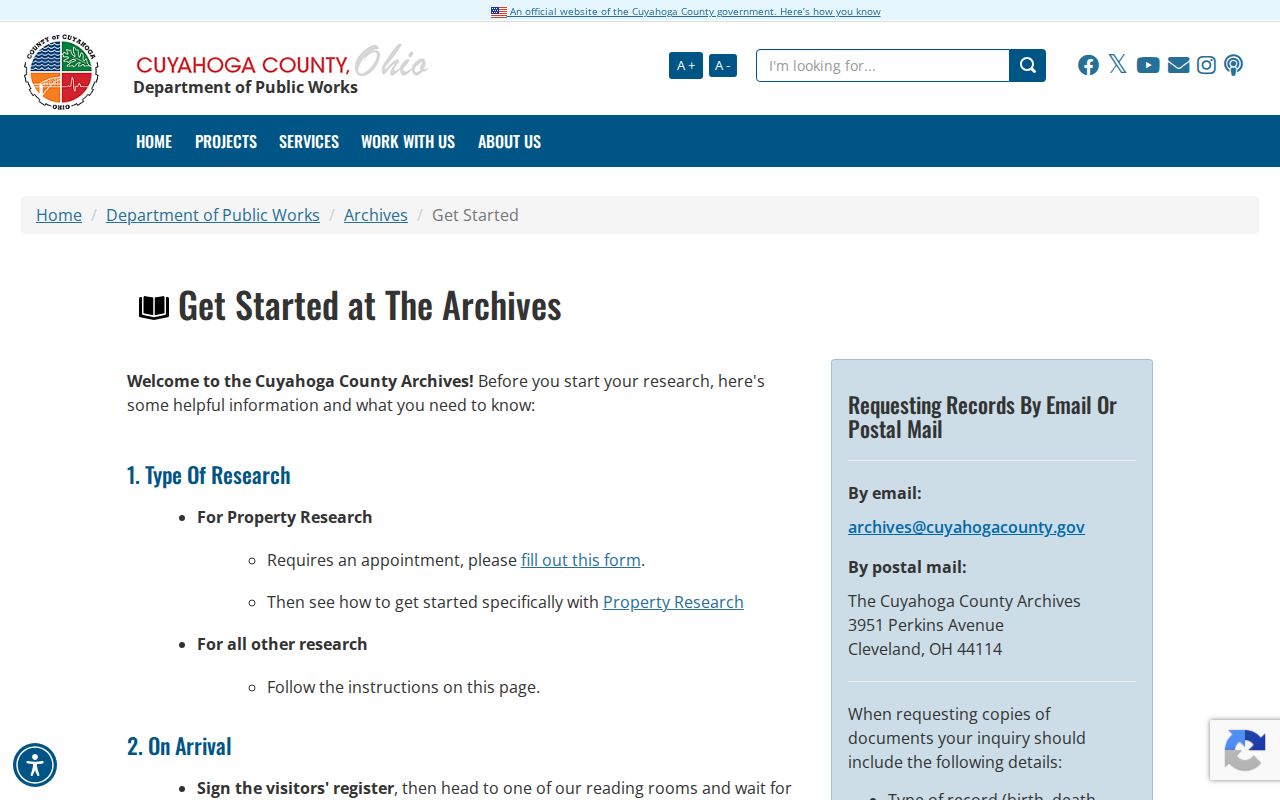
The collections route matters when a digitized title is unavailable, because the Archive's material is broader than a web search result.
Cuyahoga Directory Map Context
Maps help decide whether an address in a city-directory entry still refers to the same place. The Cuyahoga County Public Library Sanborn resource offers searchable historic fire-insurance maps from 1867 through 1970 in more than 400 Ohio communities, subject to library access rules. County Archives also holds county atlases for 1852, 1874, 1892, and 1903 and Cleveland atlases for 1881 and 1898. A map can support a dated street, lot, or structure question; it does not turn a directory entry into proof of present occupancy.
The Sanborn resource is best used after the directory year and municipality are known.
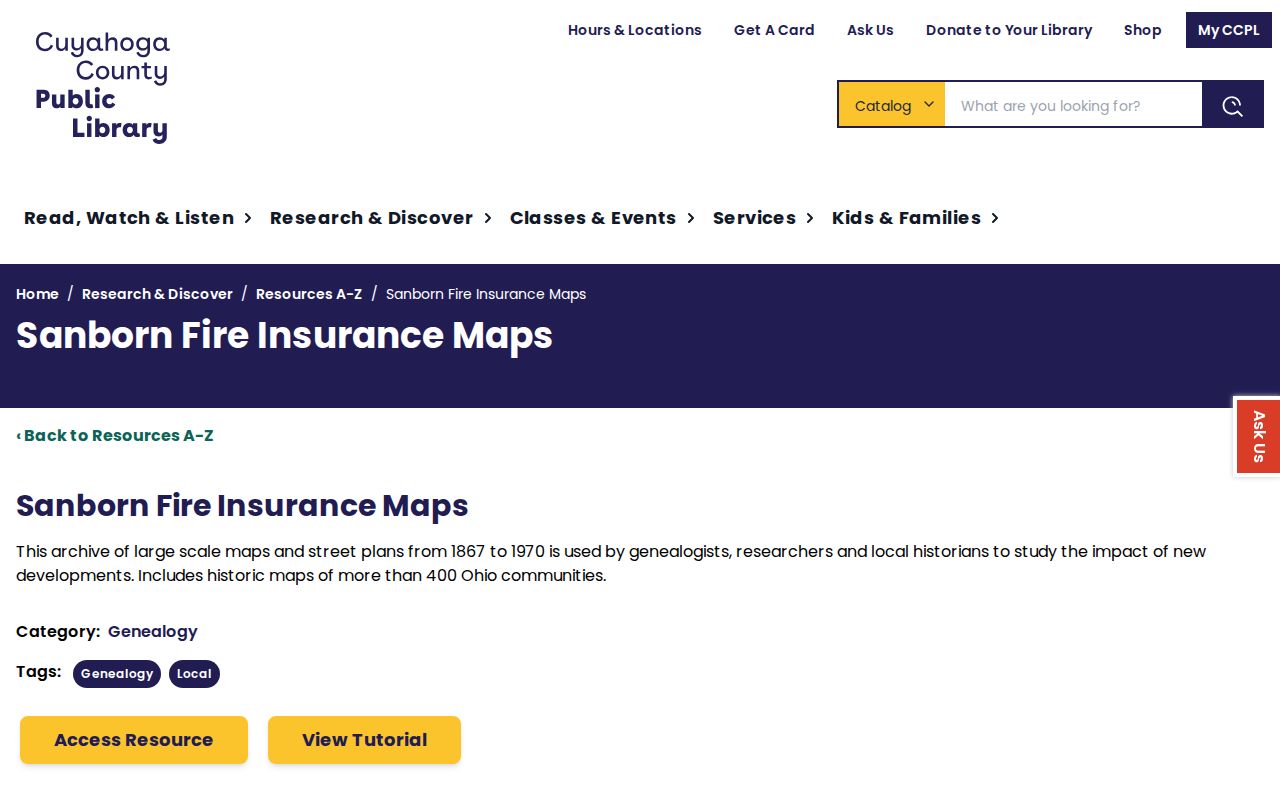
Pairing a map close in date to the volume helps account for changing street names, dimensions, and descriptions.
Tracing Cuyahoga Historical Volumes
A Cuyahoga County historical directory trail works best when each step stays dated. Start with the latest confirmed name or address and move one or two available editions in each direction. Use the post-1929 address section to match a street number, then return to the alphabetical entry for the name and occupation. For an earlier address, maps and tax material are a better bridge than pretending the reverse section existed. Federal census schedules provide a useful household snapshot near a directory year, but their release and enumeration timing are separate from publication timing.
- Record the exact name, spelling, address, occupation, municipality, and edition year from the first entry.
- Check the next available directory year on each side, allowing for the documented nonpublication gaps.
- For 1929 and later, check the address section and preserve both the address and alphabetical findings.
- Read the title page when the address is in a suburb, then locate the appropriate separate directory if needed.
- Pair the dated directory finding with the nearest available census or map and label each source by its own date.
When a historical listing needs a modern confirmation, move to the Cuyahoga County resident lookup records owned by the relevant current custodian instead of treating an old volume as a present-day answer.
Cuyahoga Directory Research Partners
For a Cuyahoga County family-history question that survives the local directory shelf, the Western Reserve Historical Society genealogy resources provide another established Northeast Ohio research channel. Its research material includes genealogy collections and databases, but current hours and catalogue availability should be checked directly before a visit. It complements the library and County Archives rather than replacing the edition-specific work done in a Cleveland directory.
The Western Reserve research page is a good starting point for the broader regional context that can explain a name, cemetery reference, or family record.
Keep the local directory citation with any later genealogy finding so a future researcher can return to the correct volume and page.